

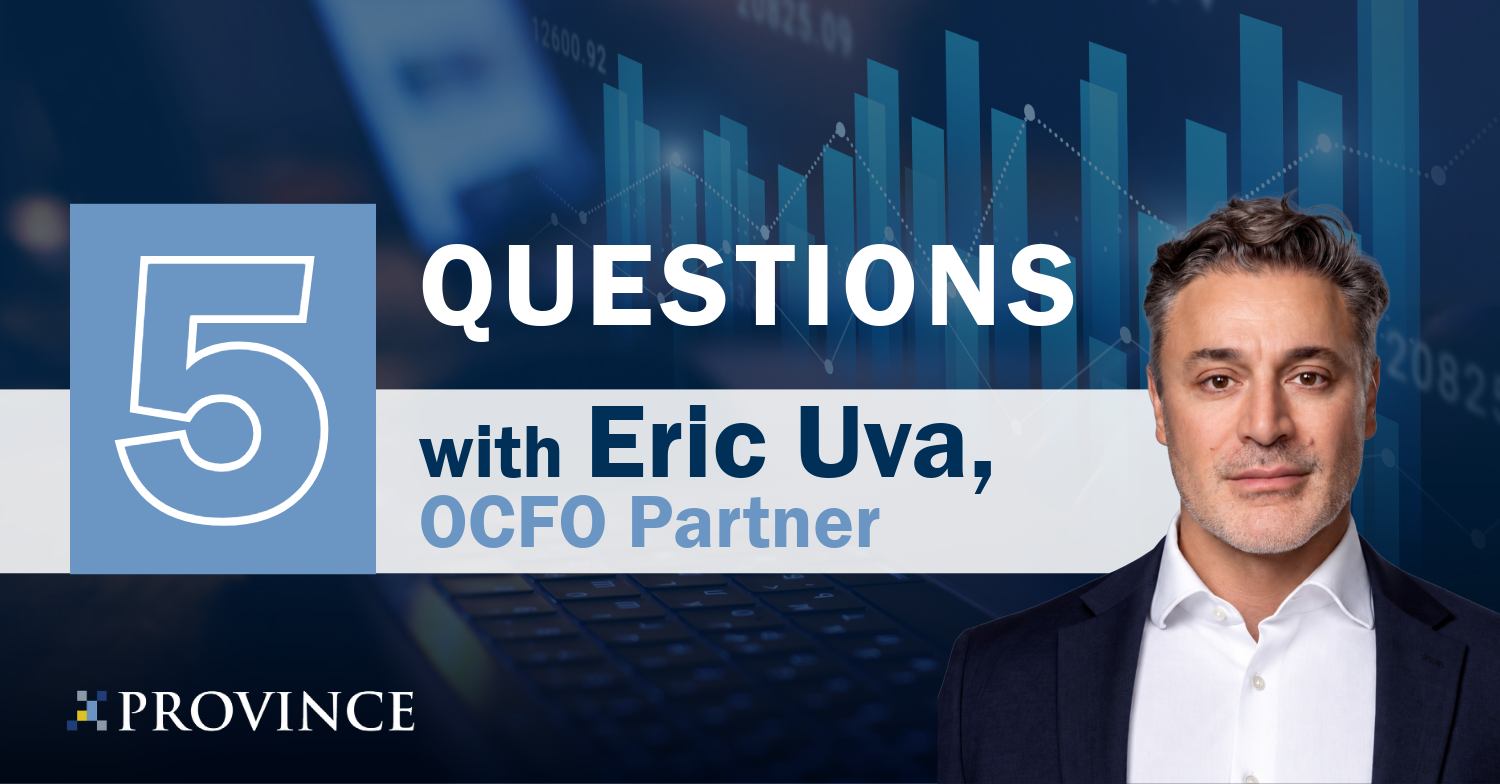
Eric Uva, a Partner in Province’s OCFO Practice, provides his perspective on the latest trends in finance leadership, value creation, and how Province can help organizations achieve their short and long-term vision.
1. How has the market shifted for outsourced financial leadership, and why are companies seeking third parties instead of applying in-house talent to address issues?
Several factors are at play. First off, what I see is that most often the pain point is a capacity issue, not a capability issue. A company may have a capable CFO and finance team, and still need experienced help integrating an acquisition, rebuilding a forecast, or improving how earnings turn into cash. The field of play for finance has widened, and the pace of value creation now demands a quicker reaction time. This creates timing and capacity constraints.
Oftentimes, sponsors and CEOs need finance to simultaneously explain performance, anticipate cash needs, support acquisitions, and help deliver improvements in earnings. An acquisition needs integrating now; a forecast needs rebuilding before the board meeting next week. A permanent hire takes time and may not be required full-time.
At Province, we approach OCFO as operators. We agree on what work needs an owner and bring leadership and execution capacity to carry it through. That can mean working alongside the CFO, leading a specific initiative, or filling an interim role. The objective is a finance function that helps the company make decisions and execute its plan. The finance function should be a source of value; we do that by improving earnings and converting those earnings into cash.
2. When should a company consider bringing in outsourced CFO support, and what are the key signs that its existing finance function needs additional expertise?
The most telling signs show up in the day-to-day work. The close begins to slip. Forecasts repeatedly miss their targets. No explanation exists for which customers, products or branches are causing margin erosion, or explanations arrive after the decisions have been made. An acquisition closes, but its reporting and financial processes remain disconnected from the rest of the business.
In general, the right time to bring in OCFO support is when the demands on finance begin to exceed the team’s ability to respond reliably. A CFO departure is an obvious trigger, but the warning signs often appear much earlier in daily operations. That is the time to act, before those gaps become a cash shortfall or a missed earnings target.
Outside support should match that gap and no more. Having worked as an investor, a portfolio company CFO, and an advisor, I start by identifying what is missing: leadership, capacity, technical expertise, or process reengineering. A strong CFO may need an experienced person to own integration while the team handles the close and daily operations. At Province, we define the gap early. This gives management a clear starting point and protects the team’s ability to run the business.
3. What role do financial leaders play in helping organizations make more informed strategic decisions during periods of economic uncertainty or market volatility?
We want finance to act as a catalyst for growth, not a brake on it. Uncertainty will always exist, but finance should contain it enough for management to act. That starts with understanding what levers actually drive the business: customer demand, pricing, input costs, staffing, inventory levels, and collections timing.
Operations lead the way; finance follows. What occurs between order and cash? How do pricing and productivity show up in our view of EBITDA?
Take a growing company considering a large new customer. The revenue upside may be compelling, but the company could need inventory and additional people well before it collects the first invoice. Finance needs to show the expected margin, the cash required, and what happens if the ramp takes longer than planned. Management can then negotiate terms, stage the investment, or adjust the timing.
At Province, we draw a straight line between analysis and implementation. We work with the management team to translate risk exposure into practical choices that keep the business moving forward. In instances where a decision requires expertise in capital markets, technology, or risk, we can draw on the broader Province team while maintaining clear responsibility for the finance work. Management should leave the discussion knowing what it will do next and how it will measure the result.
4. What are some of the most common financial challenges you see facing middle-market companies?
Oftentimes, the business has become more complex than the finance function was built to support: new locations, new products, and corporate acquisitions all add demands before the company has consistent infrastructure or processes in place to support growth.
Acquisitions add another test. An acquisition adds EBITDA, while the expected savings remain difficult to verify across different reporting systems. Finance can become consumed by assembling the numbers while those operating issues are still unresolved.
In an engagement at a PE-backed manufacturer missing plan, we broke down what was driving EBITDA and reviewed performance weekly to support cost reductions and plant consolidation. That work contributed to a $39 million EBITDA improvement over eight months.
Technology and AI can also help reduce repetitive work and re-engineer processes. At Province, we work seamlessly with technology and AI specialists to streamline processes and improve how information moves through the business. We know technology is not one-size-fits-all, and work to ensure solutions are right sized for your business needs.
Our approach is practical and straightforward: we define the problem and stay involved until the changes achieve their intended results.
5. As businesses face increasing complexity, what should executives look for in an outsourced CFO partner?
Start with who will actually do the work. Have they carried responsibility for finance inside a business like yours? Do they understand how your business makes money? Like-for-like industry experience matters. In a founder-led business, can they build trust and help the founder make confident decisions that move the company forward?
Leadership should ask what will be tackled in the first week and what they would need to learn before making changes. Also, the team should arrive with a playbook and know how to adapt it.
Then ask: What should be different in the business at the mandate’s end? The answer could be a dependable cash forecast, consistent reporting across an acquisition, or a margin improvement plan with named owners and results tracked against a baseline. Get specific about the expected result, who’s responsible, and how you’ll review progress. The scope, fees, responsibilities, and review points should be clear enough for management to make an informed decision.
The handoff matters, too. Look for a partner who develops your people, documents the processes, and leaves clear accountability behind. The engagement should strengthen the company’s ability to run finance and make decisions after the outside team steps away.
At Province, we start with the business need and put experienced leadership close to the work, supported by the specialists the situation requires. Operator-first senior executives lead lean teams focused on mandate-driven outcomes. We agree on priorities with management and the sponsor and work alongside the existing team through implementation.
Contact Eric Uva to if you have any questions or would like to explore how Province can help.
Disclaimer: The views expressed in this article are those of the author and do not necessarily reflect the views of Province, LLC or its affiliates. This article is provided for informational purposes only and does not constitute legal, financial, or other professional advice.